Monday, September 13, 2010

“400-milliion-won luxury girl” 4억명품녀

As part of Korea's "tradition" of Nyeo (녀, girl) phenomenon, here's another controversial scoop that led to another  nyeo/girl term, the  “400-milliion-won luxury girl” (4억명품녀). In my previous entry, I also featured Rude Girl (경희대 패륜녀) as one of the examples.

A jobless daughter of rich parents can freely brag about her luxurious life on a cable TV program. But it could become a wholly different matter when the issue of gift tax is raised.

Appearing on m.net’s “Tent in the City” that was aired on Tuesday, the 24-year-old girl, Kim Kyung-ah, bragged that her outfit and accessories she was wearing were worth more than 400 million won ($343,000).

Introducing herself as jobless, she said “pocket money” given by her parents has enabled her to buy luxury clothes, accessories and travel overseas at any time.

In a self-filmed clip at her house, Kim boasted that her car was worth more than 300 million won and other designer-brand clothes along with accessories on display at her home in an upscale district in southern Seoul.

Her bragging caused a huge stir on the Internet and irked many. And a question was raised among netizens whether the girl, now famously known as the “400-milliion-won luxury girl,” is subject to any gift taxes.

Following the episode, the National Tax Service (NTS)’s website was bombarded with articles by angry citizens, who called for an intense tax audit of her parents.

“Her lavish spending was impossible without financial support from her parents,” an article read. “The authorities need to audit them to check whether they took appropriate steps to hand down their wealth to the daughter.”

Under the law, the maximum amount in gifts to the second generation without paying tax is set at 30 million won. At a session of the National Assembly, NTS head Lee Hyun-dong promised lawmakers it will look into the case.

However, as the tax authorities are moving to launch a tax audit to find any irregularities in maintaining her spending spree, the 24-year-old woman ate her words.

She said she was not as rich as shown by the program and insisted she just “acted” based on a script provided by staff, indicating that the non-fiction program was, as a matter of fact, fabricated to attract viewers’ attention.

But the program’s producer, m.net, an entertainment-only channel, is balking at her allegation, saying the program was not scripted and her lavish spending shown in the episode was clearly “real.”

For its part, the state broadcasting regulator said it will open an investigation into the program this week to check their clashing claims.

by Park Si-soo

Related Article
Korea's Paris Hilton
By Ryu Jeong-hyun (Intern Reporter)

Rude Girl 경희대 패륜녀: http://jmsupercuteinkorea.blogspot.com/2010/05/issue-101-rude-girl.html

Sunday, September 12, 2010

'Pretty' men sweep electronics commercials

Television commercials for domestic appliances like refrigerators, ovens and laundry products are obviously aimed at women. What marketers can’t decide, however, is whether it’s better to have the products endorsed by beautiful women or men just as pretty.


It wasn’t long ago when famous actresses like Song Hye-kyo and Ko Hyun-jung were dominating the television advertisements for ``kimchi’’ refrigerators, which are specially designed for maintaining the Korean staple dish of fermented cabbage.

But it now seems that major consumer electronics makers like Samsung Electronics and LG Electronics have decided they would rather use male celebrities to lure female customers.

Actor and singer Lee Seung-gi is now appearing in television advertisements for Samsung’s ``Zipel’’ kimchi refrigerators, and midsized maker Winiamando has a pair of movie hunks in So Ji-sub and Yoo Seung-ho touting its kimchi refrigerators.

Completing the male sweep is LG, which recently signed the footballing duo of Cha Du-ri and Ki Sung-yueng, both playing for Celtic in the Scottish Premier League, to appear on television commercials for its ``Dios’’ brand of kimchi refrigerators later this month.

Male celebrities are competing with their female counterparts in the advertisements for kitchen appliances as well. Alex, a singer and renowned foodie, has been the local spokesman for French appliances maker Tefal.

In his recent movie, ``The Man from Nowhere,’’ actor Won Bin played the role of a retired secret agent who embarks upon a blood-splattering revenge mission for a kidnapped child. But he’s all-sweet in the commercial for Cuckoo’s new rice cooker, ``Pink Rose,’’ buying flowers, doing the dishes, and casting his patented doe-eyed stare at the rice cooker as he waits for his imaginary girlfriend to return from work.

``A lot of women will be willing to trade places with that rice cooker,’’ a Cuckoo spokesman said.

Laundry products are a rare home appliance where actresses are defending their endorsement turf. Samsung and LG have Han Ga-in and Lee Na-young, respectively, promoting their premium washing machines. Apparently, the logic is that women want men to cook for them, but women still can’t trust men to erase the stain on their skirts.

``Electronics makers have long relied on actresses and female models in gender targeting, connecting an image of `high living’ to their domestic appliances products and stoking the desire for self-reward in female customers. But now they seem to believe that using attractive men provides a better way to aim at female customers,’’ said an employee from a Seoul-based advertisement company.

At least the actresses still have their apartment commercials.


By Kim Tong-hyung
thkim@koreatimes.co.kr
http://www.koreatimes.co.kr/www/news/biz/2010/09/123_72888.html

Thursday, September 9, 2010

Tragedy fails to shake Filipina's belief in Korea

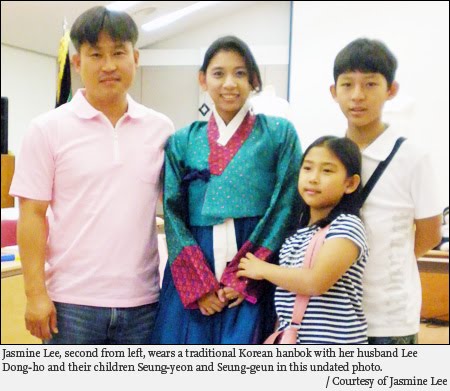
Few have become a symbol of Korea’s multiculturalism like Jasmine Lee.


Lee, who has appeared on television shows such as KBS’ ``Love in Asia’’ and a cameo in the hit film ``Blood Brothers,’’ had no inkling her life would turn out this way when she first arrived in Korea in 1995.

The pretty and dusky Filipina was a 17 year old college freshman in 1994 when she met Lee Dong-ho, then 29, a seaman who was staying in her hometown in Davao, southern Philippines. Despite their age gap, the romance led to marriage a year-and-a-half later.

Their marriage initially encountered opposition from his parents, who did not understand why their eldest son would want to marry a foreigner. Plus language was also a big barrier, so she had to learn quickly.

``I didn’t even have a chance to teach my children English or Tagalog when they were small because I was busy learning Korean. We lived with my husband's parents and grandparents in the same house, and they’re old. We didn't understand each other. It was impossible for me to ask them to learn English, so I learned on my own,’’ Lee, who is now fluent in Korean, said.

At that time, there were no free Korean language classes, so Lee studied Korean from books, watched television dramas, and practiced with her husband and family members.

When she went outside, Lee endured blatant stares and prying questions from Koreans on the street. ``If I tell them I’m married to a Korean, they would always ask, `Why? How did you meet? What does your husband do?’ I always thought, `why do they have to ask those questions?’ It was too stressful to answer those questions,’’ she said.

Lee also had to deal with people’s misconceptions about the Philippines. Instead of getting offended by some Korean people’s negative opinions about her country, she tried to understand where they were coming from.


``I didn't blame them because they only saw the documentaries about poverty in the Philippines. Some people only knew the country was poor and some would tell me there are a lot of pickpockets and beggars,’’ she said.


Becoming Korean

In July 1996, she gave birth to a son Seung-geun, but when she saw the family registry, it only included her husband and son’s name.

``Since I was a foreigner, I was not included. I was living under the same roof, but the government does not recognize me as a person living in that house. Am I a ghost? My child does not have a mother? So I decided to change to Korean citizenship (in 1998),’’ she said.

Even after becoming a Korean citizen, Lee still felt very conspicuous. When her son began going to school in 2002, she did not accompany him to avoid letting people know that his mother is Filipina. By second grade, she ran out of excuses and had to go to her son’s school.

``Children pointed out I was a foreigner, maybe from Africa, and I felt like a clown in a circus. I didn’t want to but I still stood out in the crowd. I was worried my son would hear these comments and deny that I’m his mother, but when Seung-geun saw me, he shouted `Omma,'’’ she remembered fondly.

It was hard at first, with other parents thinking that she was either an English teacher or a housekeeper who visited the school in place of Seung-geun’s real mother.

Her son and daughter also had to endure taunts and nasty nicknames, such as ``Philippine monkey’’ from some classmates, but Lee says her children are tough and would fight back. ``My son is cool about it, but he would fight them if they start calling his mother `wonsoongi’ (monkey),’’ she said.

While it was hard making that first step into Korean society, Lee realized it was necessary to go out more and gain acceptance. Once people became used to her, they even forgot she was a foreigner herself.

``I couldn’t live my life inside the house all the time. I realized the more I hide, the more that people don't know (about multicultural families), the harder it will become,’’ she said.

Stepping out in society


As her social circle widened, opportunities started opening up for Lee. She joined a television quiz show and a New Year's Day singing contest for foreign wives, and worked as a translator for ``Love in Asia,’’ a show depicting the lives of multicultural families.

Her happy family life was featured on the show, a welcome change from the usual sad stories. ``The writers wanted to feature my family because I was different: we were living in Seoul and in the same house with four generations of my husband’s family. Plus I was good at Korean. They said it was a perfect example of multiculturalism,’’ she said.

Soon after, Lee was hired to become a regular panelist on Love in Asia, where she met other foreign wives.

These experiences have given Lee a realistic perspective on what it means to be a multiethnic family. She regularly gives lectures about multiculturalism in Korea for teachers and student leaders.

``Each person has their own biases. We may think we don't have biases but they don't know it yet... I always tell them to discard their biases and prejudices. Some teachers think that they are protecting biracial children but their unnecessary sympathy can make it worse. The children get more annoyed when adults will make them feel that they are different from other kids,’’ she said.

For instance, when her daughter was in first grade, a teacher told the class to be nice to her because her mother is a foreigner.

``It’s wrong for teachers to have this bias that just because she is biracial, then she will be a `wangtta’ (outcast)... My daughter didn’t even tell me about that experience, but now she said it is okay because the other children are looking up to her since she’s been on TV,’’ Lee laughed.

For foreign spouses, she encourages them to make efforts to learn the language and to venture into Korean society, which she says are the keys to being accepted.

``There is a big difference between those who speak and don’t speak Korean. Especially when the children are growing up, they get annoyed when they speak better Korean than their mothers,’’ she added.

Dealing with tragedy

It has been a month since her husband Dong-ho died. He suffered a heart attack while rescuing his daughter, who was caught in a whirlpool in a mountain stream in Okcheon-dong, Gangwon province.

Lee was devastated by her husband’s death and is still coming to grips with it. ``I never realized how important he was in my life until he was gone. His mere presence was a source of comfort for me,’’ she said.

A smile passes her lips, as she recalled how Dong-ho would pick her up at the subway station, and how he took charge of household chores when she started working.

For the last 14 years she used the last name Ba, a shortened version of her real name. It was only in June when Dong-ho decided to file the paperwork necessary for Jasmine to change her surname to Lee. But in a twist of fate, Lee received the approval to carry her husband’s last name a week after he died.

```It’s his last gift for me,’’ she said, sadly. ``There were many times before when we wanted to change my name but didn't do it. Now that we did, he couldn't even wait for me to become a real Lee.’’

Lee is not sure what the future holds for her family but she wants to keep making her husband proud. ``I do want to continue what I’m doing. (My husband) was really proud of what I was doing,’’ she said.

by Cathy Garcia http://www.koreatimes.co.kr/www/news/biz/2010/09/123_72724.html

Tuesday, September 7, 2010

Hot peppers linked to cancer cell growth

This may be shocking to Koreans who consider red peppers as part of their daily dietary intake not just for health reasons and for the taste but also for its cultural significance in Korean cuisine.

Red pepper flakes and pastes have created a huge boom in East Asia for their effect in dissolving fat and leading to possible weight loss. However, those who eat them habitually for health or diet’s sake may have to think twice — a group of international researchers claim that capsaicin in the pepper may be linked to skin cancer.


According to Prof. Lee Ki-won of Konkuk University and fellow scientists at Seoul National University and the University of Minnesota, the substance has the ability to act as a carcinogen promoter, especially at the stage when a tumor is being formed.

The researchers applied capsaicin, the pungent substance that makes peppers hot, onto the skin of mice regularly for a set period of time, and found that the regular application made them more susceptible to skin cancer, with some of them developing larger tumors than others.

They also concluded that capsaicin has the potential to induce inflammation that could possibly affect cancer development.

However, the researchers said that capsaicin did not cause skin cancer in all the animals tested.

Capsaicin is widely consumed worldwide in foods containing chili peppers and others. Many use it as topical cream to treat pain.

Ann Bode, one of the researchers, said to multiple press outlets that the study results should raise concern that an over-the-counter pain reliever could increase skin cancer risks.

The ground-breaking finding was published as the cover story of the “Cancer Research” magazine’s September edition, but is expected to trigger fresh controversy over the substance.

Some studies in the past suggested that capsaicin induces cell deaths in cancer cells when administered to a cancer patient.

Some reports have claimed that the substance promotes stomach and liver cancer and also induced duodenal adenocarcinoma in mice. It is also said to enhance the metastasis of breast cancer cells by reducing the expression of relevant genes.

Prof. Lee of the Konkuk University said, “It is true that chili peppers are good for the body. The study will evolve into which part of the food does good and which doesn’t.”

By Bae Ji-sook (http://www.koreatimes.co.kr/www/news/nation/2010/09/117_72638.html)

Monday, September 6, 2010

An Invitation to the Hallyu Dream Festival 2010

Get ready for 3 straight days of all your favorite Hallyu stars at the Hallyu Dream Festival in Gyeongju! Festivities will take place in the Gyeongju Citizen Stadium and the Gyeongju Indoor Stadium from September 10th~12th and will include a mix of cultural contents celebrating the fashion, music, and drama that have come to define Hallyu worldwide.

Main events include “Meet Hallyu Stars” and ““Lee Yeong-Hui Fashion Show” and culminate with the Hallyu Dream Concert, a series of stupendous performances featuring 23 of today’s hottest groups such as: Super Junior, 2AM, 2PM, 2NE1, Seven, 4Minute, Beast, Son Dam-bi, Kara, After School, MISS A, FT Island, Chosinseong, Da Vichi, T-ara, MBLAQ, U-Kiss, Secret, Flower, Seo In-guk, Shinee, Iru, and Nine Muses. If you’re a fan of K-Pop, this is one event you can’t miss out on!

At the festival, there will also be a wide variety of side events such as the “Reenactment of Queen Seondeok,” a queen of the Silla Dynasty (57 BC-935 AD); “Rice cake & Liquor Festival”; and a number of performances and exhibitions celebrating the many fascinating aspects of Korean culture past and present.

In celebration of ‘Visit Korea Year 2010~2012,’ the festival seeks to bring locals and internationals together in appreciation of Korean culture and arts. As an added bonus for international visitors, the Visit Korea Year Committee will be offering a limited number of FREE tickets. Those interested in free passes to this exciting Hallyu extravaganza are asked to apply for tickets at the official site of the Visit Korea Committee (http://english.visitkoreayear.com) by September 7th.


More Info
☞ Go to the official site of the Visit Korea Year Committee (Korean, English, Japanese, Chinese)
☞ Go to the website of Hallyu Dream Festival (Korean, English, Japanese, Chinese)
☞ For more information on the festival hallyudream@hotmail.com (Korean)
☞ Korea Travel Phone +82-53-1330 (Korean, English, Japanese, Chinese)

Courtesy of: Visitkoreayear.com