
Showing posts with label Travel Korea. Show all posts
Showing posts with label Travel Korea. Show all posts
Thursday, November 10, 2011


Friday, November 4, 2011
Experience Korea with missA and 2PM!
Finally the interactive movie 안녕(Annyeong) is already available. You can check it through this link
http://www.ibuzzkorea.com/eng/
 I've been waiting for this ever since buzz KOREA gave me a chance to meet and talked with miss A and 2PM during the production presentation of the said interactive movie. It was an exclusive event with the local press, some tourists from Singapore, China, Japan and Europe and us bloggers.
Here's a video to give you a glimpse of the interactive movie
Brief Information the Interactive Movie Annyeong (안녕)
 The interactive movie Annyeong is another strategy to promote Korea's tourism. This movie is a product of the collaborative efforts of the Korea Tourism Organization and buzz Korea.
Annyeong (안녕) is probably the most common Korean verbal expression. It has three meanings. Hi, Bye and Wishing someone for more blessings. Depending on the context you can just use this word as you like.
If you click the link above you will get to experience Korea online together with missA and 2PM. It's interactive because you can plan your own three-day trip to Korea depending on the choices presented to you. You go to different places in Korea with them, either you run or be guided, eat Korean food, wear Korean fashion, watch performances and you can even take pictures with them. Try it, it's really fun. It's neat, very informative and awesome! haha
During the production presentation, miss A and 2PM expressed their thoughts while making the movie and what happened behind the scenes. They said it was fun making the film and they really feel so honored to do something for Korea. After that there was a fan signing. Here are some clips I took during the event.

 What are you waiting for! Try it now!
Visit
www.ibuzzkorea.com
for more surprises!
http://www.ibuzzkorea.com/eng/

Here's a video to give you a glimpse of the interactive movie
Brief Information the Interactive Movie Annyeong (안녕)
 The interactive movie Annyeong is another strategy to promote Korea's tourism. This movie is a product of the collaborative efforts of the Korea Tourism Organization and buzz Korea.
Annyeong (안녕) is probably the most common Korean verbal expression. It has three meanings. Hi, Bye and Wishing someone for more blessings. Depending on the context you can just use this word as you like.
If you click the link above you will get to experience Korea online together with missA and 2PM. It's interactive because you can plan your own three-day trip to Korea depending on the choices presented to you. You go to different places in Korea with them, either you run or be guided, eat Korean food, wear Korean fashion, watch performances and you can even take pictures with them. Try it, it's really fun. It's neat, very informative and awesome! haha
During the production presentation, miss A and 2PM expressed their thoughts while making the movie and what happened behind the scenes. They said it was fun making the film and they really feel so honored to do something for Korea. After that there was a fan signing. Here are some clips I took during the event.

 What are you waiting for! Try it now!
Visit
www.ibuzzkorea.com
for more surprises!
Wednesday, July 27, 2011
Travel Korea: Nakcheon ri, Jeju

Humble Origin
 According to the source I've read, more than 200 years ago, the land was named “Nakcheon,” literally meaning “happiness,” because it offered its villagers a life of Arcadian features: fertile soil, fresh water and ample space to raise a family. Now Nakcheon-ri is also known as the “Village of Nine Good Things.” Sadly, I am not sure what are these nine good things are but maybe it could be your chance to ask when you go there and don't forget to tell me what it is hahaha

Artistic Village

 Nakcheon’s artistic director, Yang Gi Hoon has been promoting Nakcheon ri as a place to visit for a different cultural experience. The moment we got off the bus, the painted walls attracted my attention. It was, after all a bit different from the other villages in Jeju. And what's more surprising were the chairs all over the area. I heard there are 1,000 chairs of various styles, shapes and sizes and chairs have a carving of a different phrase. The phrases were really funny, well, at least for Koreans and those who know Korean. haha.
 How to Get There
I don't really know since I went there for a conference, it was a free tour for us. haha. Anyway, the information I found says like this:
 If coming from Jeju City, take the 95 toward Ishidol and pass the Spiritual Garden. Nakcheon is along the way and it should take you about 40 minutes. You can also take the 12 towards Aewol, which will take 50 minutes.

If you are coming from Seogwipo, go towards Jungmun and pass Cheong Su. Nakcheon is along the way and it should take about 40 minutes.
 If you are traveling to Nakcheon by bus, take any bus to Shinchang, and transfer to a neighborhood bus to Nakcheon-ri. There are direct buses from the bus terminal in Jeju City but only three times a day.

Village of humble roots by Melissa Trias http://www.jejuweekly.com/news/articleView.html?idxno=501
Thursday, July 14, 2011
Jeju Special: Haenyeo 해녀

 I visited Haenyeo Musuem the last time I went to Jeju and learned many things about them. It says haenyeos are women divers in Jeju who dives, as an occupation, for about 2 minutes at depth of approximately over 10 meters in the sea. The museum has a big banner that says they are the "Mother of the Sea."
 On the other hand, a cultural psychologist living on Jeju, Anne Hilty called them "strong woman" of Jeju. She also added that they are glorified by feminists as an example of female leadership and gender equality. In her other article, she called them “mermaid of Jeju Island." She also added that haenyeos are viewed as leaders of the Japanese resistance movement, something I also learned during the tour inside the museum.
Another writer, Margaret Turton said that haenyeos hold special status in the patriarchal society of Korea. They were the head of households and gained autonomy and, as the principal wage-earners, economic independence.

Read more about Haenyeo

Friday, July 8, 2011
Dokdo Special

A brief background about Dokdo. It's consist of two main islets and numerous surrounding rocks. Altogether, there are about 90 islets and reefs,(source) volcanic rocks and a total of 37 of these islets are recognized as permanent land.(source)

I will not be talking about the issue here nor more information about the islands, since almost everything's already been written. Just search Dokdo on Google and you'll see various information you want. I will just talk about the experiences I had when I was going to the island.
Not an Ordinary Tourist Destination

Well, you cannot visit Dokdo just because you wanna have some fun or just wanna have some air, for many reasons. We were told that in a year, you can only visit Dokdo more or less 60 times. By visit, I mean the boat should be able to dock to the island's pier. It was my second time to visit the island. The first time, we were not so lucky. Even if the weather was really fine, that's what we thought, docking to the pier was impossible so after reaching the island we just went back to Ulleungdo (see links below for references). However, this year, my second time going to the island, we were able to docked on the island for around 30 minutes. Yes, 30 minutes. And that was already long and lucky enough. hahaha.
Another reason why it's not an ordinary destination is the price. Since I went there for free I didn't have a problem but other tourists paid for it. I didn't ask for the exact price but they told me it's more expensive or same as going to Jeju island. So, I guess it must be really expensive.
And the last reason, well, that I can think of, is the distance from Ulleungdo. It takes more or less 3 hours going and another more or less 3 hours coming back. Plus, if you have seasickness or maybe you're not aware that you have one, the 6-hour ride will let you discover it. Hahaha. The first time I went there, I just kept on throwing up during the whole ride. Imagine. But for the second time, I was already prepared, so I took a medicine few hours before riding the boat and it was fine.  Challenging but Interesting enough!
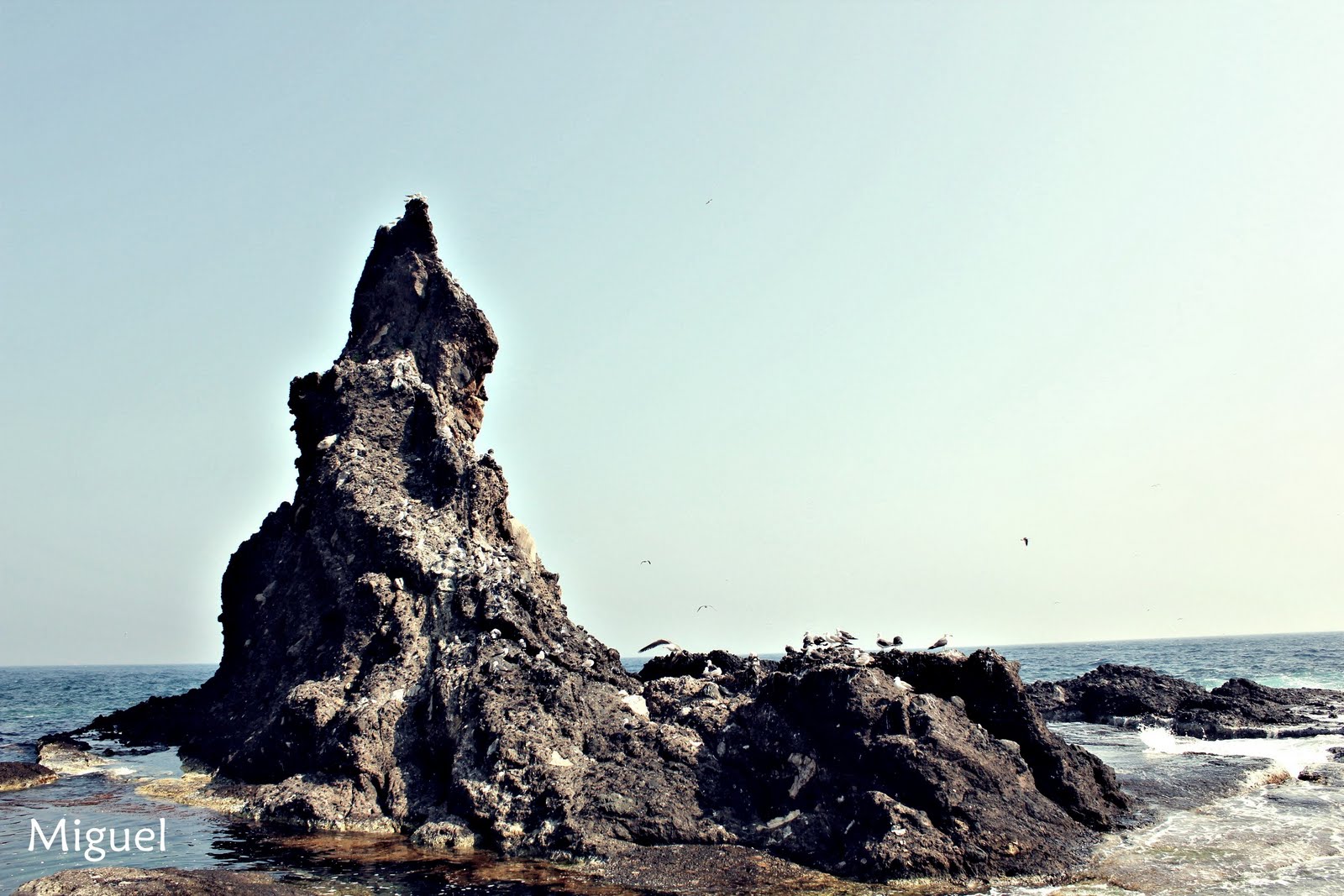
A challenging ride but I guess it was worth it. After all, not everyone can go to the island, not even Koreans themselves. Plus you can take wonderful pictures if you're into photography like me. I met many photographers when I went there. I also met these two birds who posed for my picture. hahaha. There are many pigeons on the island more than the number of people living there. I am not really sure but from what I heard there are only three official residents and 16 soldiers guarding the island.


The pigeons were my official models in Dokdo. Thank you pigeons. lol "Break the rock on Dokdo and Korean blood will flow out" is a line quoted from a poem specially made for Dokdo (see link below). All pictures are taken on the island so these are Dokdo rocks, Dokdo pigeons, Dokdo water... hehe

Links
http://joongangdaily.joins.com/article/view.asp?aid=2553214
http://jmsupercuteinkorea.blogspot.com/2010/08/ulleungdo-special-nature-trek-2.html
http://jmsupercuteinkorea.blogspot.com/2010/08/ulleungdo-special-nature-trek-part-1.html
http://jmsupercuteinkorea.blogspot.com/2010/08/ulleongdo-special.html
http://en.wikipedia.org/wiki/Liancourt_Rocks
Tuesday, October 26, 2010
Ganghwa Special: Hanok Anglican Churches
Of course who would miss the Anglican churches of Ganghwa Island. This is another feature that the island could offer to its visitors. I never imagined churches mainly of western influence not just on beliefs, practices but also on the architecture. But these Anglican churches in Ganghwa Island, are inspired by a Korean traditional house architecture called Hanok. As you can see in the pictures we took during the trip, it's truly amazing how the fusion of "modern" and traditional elements works so well in Korea.

 My friend Ben who is from UK, was the one who really wanted to see this unique collision of modern and traditional elements being expressed through the church structure. We went to Ganghwa Anglican Church although there are still 2 other churches I guess.


"Also known as Saints Peter and Paul Anglican Church, Ganghwa Anglican Church first opened in 1893. King Gojong — looking to score points with the British, I’m told — lent the missionaries a palace woodcutter who had participated in the 1867 reconstruction of Gyeongbokgung Palace. The result was a splendid church marrying royal palace, Buddhist and Western architectural elements. The layout of the church ground, with its gates and bell pavilion, is quite similar to the layout of a Korean Buddhist temple. The dancheong, roof spines and gargoyles recall Korean official buildings such as one might see at one of Seoul’s royal palaces. The interior, meanwhile, is a hanok interpretation of the Western basilica."
 Other Anglican churces in Ganghwa Island are Ganghwa Onsuri Anglican Church and Seodo Central Methodist Church. Please click this link for more detailed information about the island's Anglican churches. http://www.rjkoehler.com/2008/03/03/hanok-anglican-churches-of-ganghwa-island-and-jeondeungsa-too/
Monday, October 25, 2010
Ganghwa Special: Dolmen Sites (Goindol)

Dolmens (Goindol), prehistoric rock tombs built by Megalithic cultures in the 1st millennium B.C. can be found all over the world but around 30,000 of it are in North and South Korea. In South Korea, Ganghwa Island houses the biggest of its kind (others can be found in Gochang and Hwasun) and probably the most number. There are 80 dolmens in the island itself. The purpose of these dolmen are said to be a mystery same with other dolmen sites in the world.

 Our first stop was Dolmen Site (Goindol) not just because it’s the most famous spot in island but it’s not that far from the bus station. The area was huge and really clean. We went there with a perfect autumn weather…also a perfect timing for taking pictures. Interesting enough, the background songs played were all K-pop music so it was like enjoying prehistoric Korea with a mix of modern Korean pop music. When we went there, a museum was being built for the purpose of informing the public more about dolmen and prehistoric Korea.

FYI: Appointed as Historical Site number 137 and dates back to the Bronze Age. It used vast stone measuring 710cm in lenght, 260cm in height, and 550cm in width. Its formation is representative of the northern Dolmen and is used for detailed research on ancient history. At the Australia Keynes 24th UNESCO World Heritage, Ganghwa dolmen was appointed as world heritage together with the Gochang and Hwasun dolmens in November 29th, 2000.
Useful Links:

Sunday, October 3, 2010
Saturday, October 2, 2010
Wednesday, September 1, 2010
Gwangju Special: Hub City of Asian Culture

Another lifetime benefit of becoming a member of World Students Korea is a free trip to different parts of the country. This time we went to Gwangju. Known as the city of light based on its Chinese character Gwang (광,光?, which means "light" and Ju (주, 州) which means "province.
Brief Information About Gwangju:
 Gwangju is the 6th largest city in South Korea. Used to be the capital of South Jeolla Province until 2005 and was once a major political and economic centre of Korea ever since.57BC being an administrative centre of Baekje during the Three Kingdoms Period. It’s a 3.5 to 4-hour bus ride from Seoul with one 15-minute break after 2 hours so it’s not tiresome at all. The roads are good and buses are more than good so nothing to worry about it. Since I already featured the May 18th Uprising and the Gwangju World Music Festival in my two other entries, I will feature the newest project of the city.

Gwangju: Hub City of Asian Culture
 According to the guide who explained to us about the project in detail, so far this is the biggest cultural project in Korea. It seeks to promote awareness of Asian Culture through different venues and ways in the cultural complex, Asian Culture Complex, which is currently being made in the center of Gwangju City. “Western” culture has been known and popular throughout the world even in Asia. This project would aim to put Asian Culture in the limelight in a world class arena at the same time preserve and let everyone know about it through exchanges. There are five main institutions that will be built, each catering to different sorts of cultural expression. Cultural Exchange Agency, Asian Culture Information Agency, Cultural Promotion Agency, Asian Arts Theatre and Edu-Culture Agency for children. For more information visit http://www.cct.go.kr/english/index.do


The project is expected to finish on 2014. Although I'm not going to be here anymore at that time, I hope I could come back and witness it. It was raining that day but good we were able to accomplished all the scheduled sights and activities. I enjoyed the food since it was "authentic" Korean food. we went Gwangju's most famous restaurants. Lunch was in a very cozy place 에루화, while dinner was bibimbap in 예향촌 another popular restaurant in Gwangju.

Tuesday, August 31, 2010
Gwangju Special: May 18 Democratic Uprising


Nobody thought that the May 18 Uprising in Gwangju against the dictatorship of Chun Doo-hwan could leave an eternal scar in the hearts of Korean people. The incident could probably be the biggest human casualty in the modern history of Korea for the sake of democracy. A fight that Korea shared with the world. I think Gwangju is truly the birthplace of Korean democracy.

May 18 Memorial Tower

The structure is huge. It serves as a gate to the “main” cemetery. According to the guide, the folded hands structure and the egg shape in the center combine to symbolize the resurrection of life and the reflection of the sunlight from the Tower represents the seed of hope.
After that we watched a documentary about the May 18 Uprising. I almost cried while watching it. I couldn’t believe that it happened also in Korea. What I mean by “also” is that because it also happened in the Philippines. For the sake of democracy many people died.

http://www.518.org/
http://libcom.org/history/1980-the-kwangju-uprising
http://en.wikipedia.org/wiki/Gwangju_massacre


Subscribe to:
Posts (Atom)